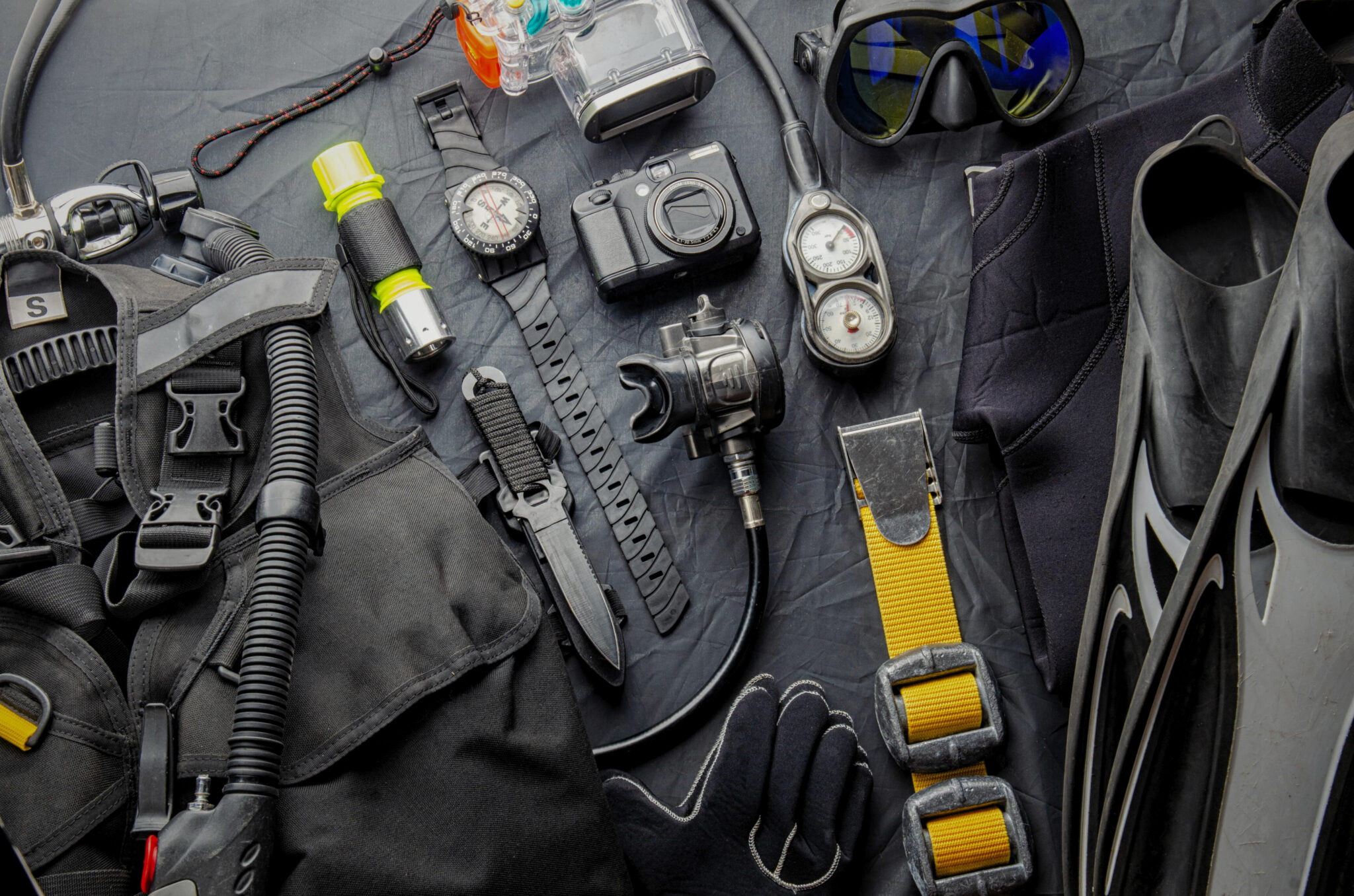
You just got certified. The card is in your wallet, the dive bug has bitten, and you're already planning your next trip. At some point — usually right around now — the question hits: should I buy my own gear?
The short answer is yes, eventually. But you don't need to buy everything at once, and knowing what to prioritize will save you hundreds of dollars and a closet full of regrets. Here's how to build your kit the smart way.
Buy Personal Fit Items First
The gear that matters most early on is the gear that needs to fit your body. Rental equipment is one-size-fits-most, and "most" is doing a lot of heavy lifting in that phrase. Ill-fitting gear doesn't just feel uncomfortable — it affects your diving. A leaky mask ruins your focus. Loose fins waste energy. A wetsuit that doesn't seal properly lets cold water flush through on every kick.
Start with these three pieces, in this order.
Mask
This is the single most important piece of gear you'll own. A mask that fits your face properly won't leak, won't fog as easily, and won't leave you with pressure marks after an hour underwater. Rental masks are used by dozens of people with different face shapes — the odds of getting a great fit are low.
When shopping, the fit test is simple: press the mask gently against your face without using the strap, inhale through your nose, and let go. If it stays put without air leaking in around the skirt, it fits. Try several models. Low-volume masks (where the lenses sit close to your eyes) are generally better for diving because they're easier to equalize and clear, and they give you a wider field of view.
Expect to spend $40 to $120 for a quality dive mask. Tempered glass lenses are non-negotiable — they're required for safety at depth. If you wear corrective lenses, many masks accept prescription lens inserts, which is far better than trying to dive in contacts.
Fins
Fins are the second priority because, like masks, fit is personal and performance varies dramatically. The two main styles are full-foot fins (which slip on like a shoe) and open-heel fins (which use an adjustable strap and are worn with dive boots).
For most divers, open-heel fins are the better choice. They accommodate dive boots, which protect your feet on shore entries and keep you warm in cooler water. They're also adjustable, so the fit is more forgiving. Full-foot fins are lighter and work well for warm-water shore diving, but they're less versatile.
Within open-heel fins, you'll find blade fins and split fins. Blade fins deliver more power per kick but require more leg strength. Split fins are easier on the knees and ankles and work well for flutter kicking, but they're less effective for frog kicks and precise maneuvering. Try both if you can.
Budget $80 to $200 for a solid pair. Don't forget to buy boots if you go open-heel — $30 to $60 for a basic neoprene boot.
Wetsuit (or Exposure Protection)
Rental wetsuits have seen things. They've been worn by hundreds of people, repaired multiple times, and often lost much of their thermal insulation. More importantly, a wetsuit that doesn't fit snugly lets water circulate freely, which defeats the entire purpose.
Thickness depends on where you dive. For tropical water (80°F+), a 2mm or 3mm shorty is usually enough. For temperate water (65–80°F), a 5mm full suit is standard. For cold water (below 65°F), you'll want a 7mm suit or a semi-dry/drysuit — but if you're a new diver, you'll likely start in warmer destinations.
Fit should be snug everywhere with no gaps at the neck, wrists, or ankles, but not so tight that it restricts breathing or movement. Women's and men's cuts differ significantly, so make sure you're trying the right one. Budget $100 to $300 for a good wetsuit.
Rent These for Now
The big-ticket life-support equipment — your regulator, BCD (buoyancy control device), and dive computer — can wait. Here's why.
Regulator
A quality regulator set (first stage, second stage, octopus, gauges) runs $400 to $1,000+, and it also requires annual servicing at $80 to $150 per visit. For a new diver doing five to fifteen dives a year, rental is significantly cheaper for the first year or two. Dive shops maintain their rental regulators to manufacturer specifications, so you're not compromising on safety.
When you do buy, prioritize breathing performance and reliability over features. Balanced diaphragm first stages and pneumatically balanced second stages breathe easier at depth. Brands like Apeks, ScubaPro, Atomic Aquatics, and Aqualung all make excellent regulators at various price points.
BCD
BCDs come in two main styles: jacket-style (the traditional inflatable vest) and back-inflate (where the bladder sits behind you). Back-inflate BCDs generally put you in a better trim position underwater, which helps with buoyancy control and air consumption. However, they're less stable on the surface for beginners who like to float upright.
A new BCD runs $300 to $800. Since your preferences will likely evolve as you gain experience, renting different styles on your first ten to twenty dives helps you figure out what you actually want before committing.
Dive Computer
This is the one piece of "rent for now" gear where buying sooner rather than later actually makes sense — if your budget allows. A dive computer tracks your depth, time, no-decompression limits, and ascent rate in real time. Having your own means you're always diving with a device you know how to read, with your dive history logged in one place.
Wrist-mount computers start around $200 for a basic model (Suunto Zoop Novo, Cressi Leonardo) and go up to $1,000+ for air-integrated models with color screens. For a new diver, a simple wrist computer in the $200 to $400 range does everything you need. Console-mounted computers are cheaper but are being phased out in favor of wrist units.
Don't Overlook the Small Stuff
A few inexpensive accessories make a bigger difference than you'd expect.
Defog solution. A small bottle of mask defog ($5) is infinitely more reliable than spit. Apply it before every dive and rinse lightly — don't rub.
Surface marker buoy (SMB). A bright inflatable tube you deploy at the end of a dive so boats can see where you're ascending. Many dive operations require them, and they're an essential safety item. $20 to $40.
Dive light. Even in clear tropical water, a small torch reveals the true colors of the reef (remember, water absorbs red light at depth). It's also essential for peering into crevices and overhangs. A compact, 500-lumen light runs $30 to $80.
Mesh gear bag. Rental BCDs and regulators go back to the shop, but everything else needs a home. A mesh bag lets gear dry during transport and keeps your car from smelling like neoprene. $15 to $30.
Buy Used — Carefully
The secondhand market for dive gear is active, and you can find excellent deals on masks, fins, wetsuits, and BCDs. Facebook Marketplace, dive forums like ScubaBoard, and local dive club swap meets are all good places to look.
A few cautions: never buy a used regulator unless you can verify its service history and have it inspected by a certified technician before diving with it. Wetsuits lose insulation over time as the neoprene compresses, so a five-year-old suit won't keep you as warm as its thickness rating suggests. And always inspect O-rings, buckles, and inflator mechanisms on used BCDs — a stuck inflator is a serious safety issue.
The Buying Order Cheat Sheet
If you're building your kit over time, here's a practical sequence: mask first (you'll use it on every dive and every snorkel), then fins and boots, then a wetsuit, then a dive computer, then a regulator, and finally a BCD. This order prioritizes comfort and fit early on, then adds the equipment that benefits most from familiarity and consistency.
Total cost for a complete beginner setup, buying mid-range gear new: roughly $1,200 to $2,500. Spread that over a year or two of diving, and it's very manageable — especially once you stop paying $50 to $80 per dive in rental fees.
Identify What You See with Your New Gear
Once you've got your own kit dialed in, you'll spend less time fussing with equipment and more time actually looking at the reef. And when something catches your eye — a fish you've never seen, an unfamiliar coral, a nudibranch hiding in plain sight — open iSea and snap a photo. Our AI identifies 2,500+ marine species in seconds, turning every dive into a learning experience.
Add iSea to your dive kit
AI-powered marine life identification — free to download.