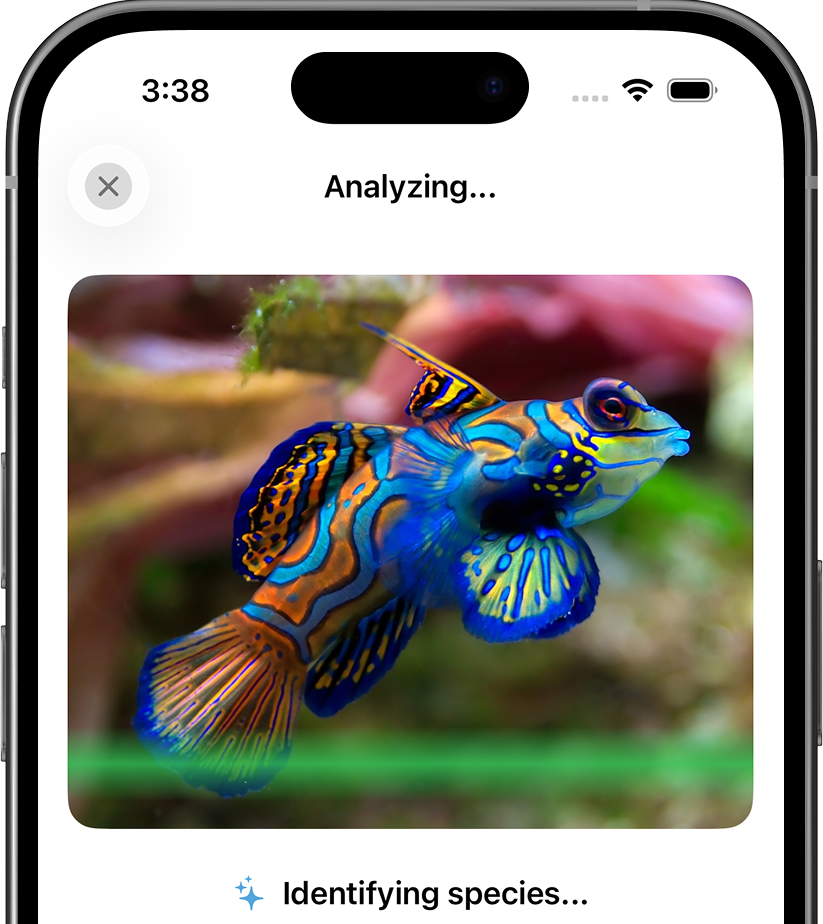
Full disclosure: we make iSea, so we're not a neutral party here. But we use — and pay for — most of these other apps ourselves, and we've tried to describe what each one actually does well, not just what we do better.
"What fish is that?" is one of the oldest questions on a reef, and lately it has one of the newest answers: point your phone at it. A whole category of AI identification apps has sprung up to answer that question in seconds, but they're not all built for the same person. Some are made for anglers who want to know if a catch is legal to keep. Some are made for backyard naturalists cataloguing birds and bugs. A few, like iSea, are built specifically for people in the water — divers, snorkelers, and freedivers trying to identify what just swam past their mask.
We put six of the most-downloaded options side by side: iSea, Seek by iNaturalist, Fishial.AI, FishVerify, Fishbrain, and Picture Fish. Here's how they stack up on the things that actually matter underwater — the AI model doing the identifying, species coverage, offline access, region-awareness, community, and price.
What to actually look for in a fish ID app
Before the comparisons, a quick word on what separates a genuinely useful app from a gimmick. Reviewers who test these apps side by side consistently flag the same weak points: species databases that are smaller than they look, coverage that quietly stops at one region or country, and photo-matching that falls apart on the kind of hazy, backscatter-heavy shot you actually take underwater. A few things worth checking before you commit to any app:
- Species coverage. A few hundred species sounds like a lot until you're snorkeling somewhere the app wasn't built for.
- Offline access. Cell signal doesn't reach very far past the shoreline, let alone underwater.
- Region-awareness. A Caribbean butterflyfish and an Indo-Pacific butterflyfish can look nearly identical — narrowing by region meaningfully improves accuracy.
- What it's optimized for. An app trained on boat-deck photos of caught fish won't necessarily recognize a live coral or nudibranch in its natural pose.
- Price and free-tier limits. Several of these apps meter free identifications aggressively — worth knowing before your third scan of the day gets blocked.
The lineup, at a glance
| App | Best for | Recognition AI | Coverage | Offline | Community | Price |
|---|---|---|---|---|---|---|
| iSea | Divers & snorkelers | Google Gemini 3.1 (multimodal AI) | 2,500+ marine species, 18+ regions | Yes, after first sync | Sighting feed, reactions, comments | Free tier; $1.99/mo |
| Seek by iNaturalist | General nature ID, kids | Custom vision model (all-species classifier) | ~80,000 species (all life, not marine-specific) | Limited | Feeds into iNaturalist's global community | Free |
| Fishial.AI | Anglers, educators, developers | Custom-trained classifier (640+ species) | 640+ fish species | No | None (also offers a developer API) | Free |
| FishVerify | Anglers & catch regulations | Not disclosed | ~500 fish species (fresh + saltwater) | No | None | Free trial, then subscription |
| Fishbrain | Serious anglers, spot-finding | Not disclosed | 300+ fish species | No | 20M+ angler social network | Free tier; Premium $14.99/mo |
| Picture Fish | Quick, casual ID | Not disclosed | Not disclosed | No | None | Free tier; Pro $8.99–$39.99 |
Pricing and coverage figures are current as of August 2026, pulled from each app's own listing or website. "Not disclosed" means the developer doesn't publish which model or method powers identification — not that one doesn't exist. App Store pricing and free-tier limits change frequently — check the current listing before you buy.
Why the AI behind the camera matters
Most identification apps, including several on this list, are built on a custom-trained classifier: a model trained from scratch to recognize a fixed list of species — Fishial.AI, for example, is trained on 2.6 million labeled images across 640 fish species. That approach works well within its training set, but it has a hard edge: shown something outside that list, or a species photographed at an odd angle, in murky water, or partially obscured by coral, a narrow classifier can fail silently or guess confidently wrong, because it has no broader visual reasoning to fall back on.
iSea's identification runs on Google's Gemini 3.1, a frontier multimodal AI model rather than a purpose-built classifier. Because Gemini reasons over color, body shape, fin structure, texture, and habitat context the way a trained naturalist would — instead of just pattern-matching against a fixed label set — it tends to hold up better on the messy, real-world photos divers actually take: backscatter, imperfect lighting, and species it wasn't explicitly fine-tuned on. Pairing that with region-narrowing (so the model is reasoning about "what lives in the Coral Triangle" rather than every fish on Earth) is what gets iSea to a specific species rather than a vague genus-level guess.
App by app
iSea
iSea is built around the moment you surface from a dive and can't stop thinking about the fish you just saw. Snap a photo (or pull one from your camera roll), and iSea's AI — powered by Google's Gemini 3.1 multimodal model, rather than a narrow classifier trained on a fixed species list — returns candidate matches with confidence scores and scientific names, narrowed by whichever of iSea's 18+ marine regions — Coral Triangle, Caribbean, Great Barrier Reef, Mediterranean, and more — you're diving in. The catalog covers roughly 2,500 species across fish, coral, crustaceans, mollusks, and other marine life, not just fish, and it's cached on your phone so it keeps working with no signal on a boat or a remote reef.
What sets it apart from the fishing apps on this list is the second half of the app: a searchable species encyclopedia you can browse and favorite even when you're not identifying anything, and a community feed where divers post sightings, tag species, and react to each other's finds — useful both for double-checking a tricky ID and for planning where to see something specific.
Strengths
- Powered by Gemini 3.1 — a general-purpose multimodal AI, not a fixed-species classifier
- Purpose-built for underwater photos, not boat-deck catches
- Covers all marine life, not just fish
- Offline-first after initial sync
- Community + encyclopedia in one app
Worth knowing
- Free tier caps daily identifications
- Newer app — fewer total ratings than long-established fishing apps
Seek by iNaturalist
Seek is the free, kid-friendly identification app from the iNaturalist Network, and it's genuinely excellent at what it's built for: any living thing, anywhere, on land or in the water. It draws on iNaturalist's enormous observation database and has grown to recognize roughly 80,000 species. The catch is that breadth: it's a generalist tool, not a marine specialist, and reviewers note it can struggle with less common deep-water or reef species compared to apps built specifically for the ocean. It's also not designed with region-narrowing for dive sites in mind.
Strengths
- Completely free
- Massive species range across all of nature
- Great for families and casual nature walks
Worth knowing
- Not marine-specialized
- Weaker on deep-water and reef-specific species
Fishial.AI
Fishial.AI is less a consumer app and more an identification engine — its "Fishial Recognition" model, trained on over 2.6 million labeled fish images across 640+ species, powers its own free app as well as a developer API that other fishing apps (including FishAngler) license. It's a strong, free option if you mainly care about identifying a fish in hand, but it's fish-only, has no offline mode, and doesn't offer the encyclopedia, community, or region browsing that dive-focused apps build around.
Strengths
- Free, well-trained recognition model
- Large labeled training dataset
Worth knowing
- Fish only — no coral, invertebrates, or marine mammals
- No offline mode or community features
FishVerify
FishVerify is aimed squarely at anglers, and it shows: alongside species ID for roughly 500 combined freshwater and saltwater species, it pulls up local bag limits, size restrictions, and season closures for whatever you've just identified, plus a catch log with GPS, weather, and solunar data. It's a genuinely useful tool if you're fishing and need to know if your catch is legal to keep — but that focus on regulations and catch-logging means it's not built for identifying live marine life you're not planning to take home.
Strengths
- Built-in fishing regulations by location
- Detailed catch logging (GPS, weather, tides)
Worth knowing
- Angler-oriented, not diver-oriented
- Smaller species database than marine-focused apps
Fishbrain
Fishbrain is really a social network and fishing-spot finder that happens to include identification — and with 20+ million anglers on the platform, it's by far the biggest community on this list. Its ID tool covers 300+ species, which is enough for common catches but thinner than dedicated ID apps. Premium unlocks fishing forecasts, extended maps, and regulation data, but at $14.99/month it's priced for serious anglers, not casual snorkelers who just want to know what they saw.
Strengths
- Huge, active community
- Strong maps and forecasting tools
Worth knowing
- Smaller species database
- Premium pricing aimed at anglers, not divers
Picture Fish
Picture Fish leans into speed and simplicity — snap a photo, get a name and a few facts about habitat and diet. It's fine for a quick answer at the aquarium or dinner table, but reviewers and users both flag two consistent issues: the free tier is metered aggressively (several App Store reviews mention being blocked from identifying anything without paying), and it has little ecological depth or ability to distinguish similar-looking species.
Strengths
- Very simple, fast interface
Worth knowing
- Aggressive free-tier paywall
- Limited detail and accuracy on similar species
Which one should you actually download?
If you're an angler who needs to know whether your catch is legal-size and in-season, FishVerify or Fishbrain will serve you better than any dive-focused app — that's genuinely not what iSea is built for. If you want one free app that identifies literally anything living, on land or in the water, Seek is hard to beat, with the tradeoff that it won't specialize in reef fish the way a marine-only app will.
But if you're the person this whole category was built for — someone who dives, snorkels, or freedives and wants to know what they just saw, browse a species library between trips, and see what other divers are spotting nearby — that's the gap iSea was built to fill. Region-aware AI matching, an offline encyclopedia of roughly 2,500 species, and a community feed built around sightings rather than catches, all in one app.
Try iSea on your next dive
AI-powered marine life identification — free to download.