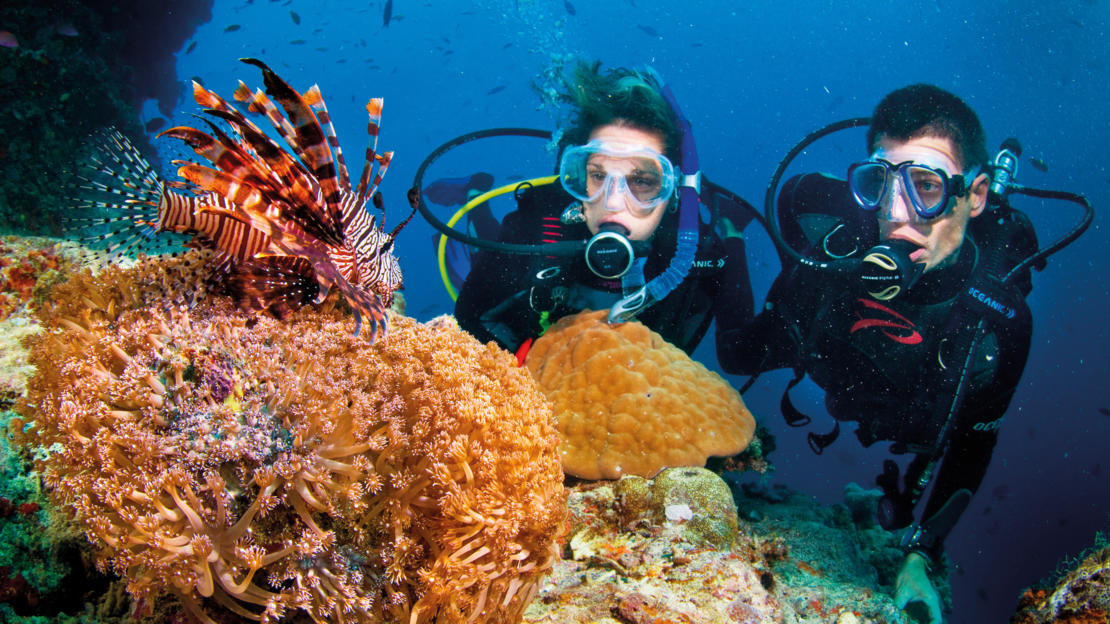
Coral reefs cover less than one percent of the ocean floor, but they support roughly a quarter of all marine species. They're also disappearing — fast. Rising ocean temperatures, pollution, and coastal development have wiped out half the world's coral cover since the 1950s, and what remains is under constant pressure.
Divers and snorkelers are among the few people who actually see reefs up close. That makes us both witnesses and, if we're not careful, part of the problem. The good news is that responsible diving isn't complicated. A handful of habits can mean the difference between a reef that thrives and one that doesn't.
Master Your Buoyancy
This is the single most important skill for reef-friendly diving — more important than any rule or regulation. A diver with poor buoyancy control is a wrecking ball. Fins dragging across coral, knees bumping into formations, uncontrolled descents crushing decades of growth in a second.
The fix isn't glamorous: practice. Spend time in a pool or open water working on neutral buoyancy until hovering motionless feels natural. Learn to make micro-adjustments with your breath instead of constantly adding and dumping air from your BCD. Keep your body horizontal and your fins above the reef, not dangling below you.
If you're a newer diver, consider a buoyancy specialty course. It's one of the most valuable certifications you can get — not for the card, but for the confidence it builds. A diver who trusts their buoyancy moves slowly, stays relaxed, and doesn't grab onto things for stability.
Look, Don't Touch
It sounds obvious, but the urge to reach out and touch something underwater is surprisingly strong — especially when you spot something beautiful or unusual. Here's why you shouldn't.
Coral is alive. What looks like rock is actually a colony of tiny animals called polyps, each one smaller than a pencil eraser. They secrete a calcium carbonate skeleton that builds the reef structure, but the living tissue on the surface is thin and fragile. A single touch from a human hand can kill the polyps underneath, leaving a scar that takes years to recover — if it recovers at all.
The same goes for other marine life. Touching a sea turtle removes the protective mucus layer on its shell. Handling a seahorse can stress it to death. Even "harmless" interactions like riding manta rays or poking pufferfish to make them inflate cause real harm. The rule is simple: keep your hands to yourself. If you can't identify something without touching it, photograph it instead and look it up later.
Mind Your Fins
Your fins are the part of your body most likely to damage the reef, precisely because they're the part you're least aware of. A careless flutter kick near the bottom can snap coral branches, stir up sediment that smothers polyps, and send a cloud of sand billowing across the reef.
A few techniques help. Use a frog kick instead of a flutter kick when you're near the bottom — it directs thrust backward rather than downward. Keep a safe distance from the reef; a good rule of thumb is to stay at least an arm's length away from any coral. And when you stop to look at something, make sure you're not sinking — check your buoyancy before you start staring at a nudibranch.
Don't Chase or Corner Wildlife
There's a temptation, especially when you're carrying a camera, to swim after an animal to get a closer look or a better shot. Resist it. Chasing a fish burns its energy reserves and pushes it out of its territory. Cornering an octopus against the reef forces it to use ink — a costly defense mechanism — for no reason.
The better approach is to move slowly, stay low, and let the animals come to you. Many reef species are naturally curious. A diver who hovers calmly and breathes quietly will see far more than one who charges around the reef with a GoPro. If an animal moves away from you, let it go.
Choose Reef-Safe Sunscreen
Every year, an estimated 14,000 tons of sunscreen wash into the ocean. Two common UV-filtering chemicals — oxybenzone and octinoxate — are particularly damaging to coral. Even in low concentrations, they cause coral bleaching, DNA damage, and deformities in juvenile coral.
Hawaii, Palau, the U.S. Virgin Islands, Key West, and parts of Mexico have already banned these chemicals. But even where it's not legally required, choosing a mineral-based sunscreen (look for zinc oxide or titanium dioxide as the active ingredient) is an easy step. Apply it at least 15 minutes before entering the water so it has time to bind to your skin. Better yet, wear a rash guard or dive skin to reduce how much sunscreen you need in the first place.
Don't Take Souvenirs
It might seem harmless to pocket a small piece of dead coral or an empty shell, but scale the habit up across millions of divers and snorkelers each year and the impact is significant. Dead coral and shells play active roles in the reef ecosystem — they provide substrate for new coral to grow on, shelter for small invertebrates, and material that wave action grinds into sand.
In many places, collecting marine specimens is also illegal, with fines that can run into the thousands. Take photos. Leave everything else where you found it.
Be Careful With Your Gear
Dangling gauges, loose octopus regulators, and trailing camera straps are all reef hazards. Before every dive, secure your equipment close to your body. Clip off your alternate air source and console so nothing hangs below you. If you're diving with a camera, make sure the lanyard is short enough that it won't snag on coral.
Anchoring is another consideration. If you're on a private boat, never anchor directly on a reef — use a mooring buoy if one is available, or anchor on a sandy bottom well away from coral. A single dropped anchor can destroy a coral head that took a century to grow.
Choose Responsible Dive Operators
The dive shop you choose matters. Operators who care about reef health will brief you on local regulations, enforce no-touch policies, limit group sizes, use mooring buoys, and avoid feeding fish to attract them. Some are affiliated with conservation programs like Green Fins, which sets environmental standards for dive and snorkel operators across the Indo-Pacific.
Ask questions before you book. How many divers per guide? Do they allow gloves (a red flag — gloves make it easier to grab coral)? Do they have a briefing on reef etiquette? The answers tell you a lot about whether a shop sees the reef as something to protect or something to consume.
Why It Matters
Reefs are resilient systems — they've survived millions of years of change. But they're not invincible, and the pressures they face today are unprecedented. As divers, we have an outsized voice in reef conservation because we've actually been there. We've seen the bleaching, the dead zones, and the patches where life is hanging on.
Every dive where you maintain good buoyancy, keep your distance, and leave the reef untouched is a small act of stewardship. Multiply that across a diving career, and it adds up.
Know What You're Protecting
Understanding the reef starts with knowing what lives on it. The next time you surface from a dive and want to identify that coral, fish, or invertebrate you saw, open iSea and snap a photo. Knowing a species by name turns a casual dive into a meaningful encounter — and makes you a better advocate for the reef.
Identify marine life on every dive
AI-powered species identification — free to download.